 2026 edition
Digital Twin for operations: a guide for owners and operators
What it really takes to run a building with a digital twin, which data to start from and how to estimate the return before you invest.
BIMON guideContents
- 01Who this guide is for
- 02What an operational Digital Twin is
- 03Which data you need
- 04The five-step roadmap
- 05How to estimate the return
- 06The Prato Hospital case
- 07When it pays off and the mistakes to avoid
- 08Checklist to get started
- 09How BIMON works
Digital Twin for operations: a guide for owners and operators
What it really takes to run a building with a digital twin, which data to start from and how to estimate the return before you invest.
Chapter 01
Who this guide is for
This guide is written for people who own or operate a building or an infrastructure asset for many years: owners, concession holders, facility managers, energy managers and technical managers of hospitals, campuses, airports and office property. You do not need detailed BIM knowledge. You need to know which decisions you take every week and which data you already have.
An operational Digital Twin is an information model of the asset that stays connected to the real asset through data from building systems, sensors and maintenance, and that is used to make decisions. If the model is not kept up to date and nobody uses it to decide, it is a good BIM model, not a digital twin. The distinction sounds academic, but it decides where the budget goes.
In the following pages you will find:
- the difference between BIM and a Digital Twin, with the five maturity levels we use on projects;
- the data you need and the typical problems of each source;
- a five-step roadmap, from the first question to an analytical twin;
- a method to estimate the return using the same buckets as our online calculator;
- the Prato Hospital case, delivered by BIMON for Impresa Pizzarotti;
- a checklist to decide where to start on your portfolio.
The guidance comes from the work BIMON has carried out since 2015 on buildings and infrastructure in design, construction and operation.
Chapter 02
What an operational Digital Twin is
Every digital twin we have built has three components.
The information model. A BIM model of the asset with the objects the use case needs: rooms, equipment, building systems, structural elements. Each object carries the attributes that matter in operation, such as asset code, manufacturer data and maintenance plan.
The data link. BMS points, meters, IoT sensors, CMMS work orders, space occupancy. Model and data must share the same identifiers, otherwise the link breaks the first time a component is replaced.
The decision loop. Someone, or an algorithm, uses the combined data to act: schedule maintenance, change a setpoint, plan an intervention. This is the part most often missing. Without it you have a dashboard on top of a model.
BIM answers the question "how should the asset be built". A Digital Twin answers "how is it performing now". The first produces models and documents that someone approves; the second produces decisions that someone takes every week. The table sums up the differences.
To understand where a building stands we use five maturity levels. They are cumulative: you cannot skip the model and jump to predictions. For most owners the biggest benefit lies in moving from level 1 to level 2, because the data already exists and the cost is mostly in putting it in order.
| BIM | Digital Twin | |
|---|---|---|
| Purpose | Design, coordinate disciplines, take off quantities, build | Run the asset: maintenance, energy, space, future works |
| Phase | Design and construction, up to the as-built | Operation, for the whole service life |
| Data | Geometry, attributes, quantities, design documents | Model plus live data: BMS, IoT, meters, CMMS work orders |
| Updates | At each revision or delivery, per the schedule | Continuous or periodic, with every reading and intervention |
| Who uses it | Designers, BIM coordinators, contractor, site supervision | Owner, facility manager, energy manager, maintenance teams |
| Output | Federated models, 2D drawings, clash reports, quantities, as-built | Dashboards, alarms, maintenance plans, consumption analysis, scenarios |
Chapter 03
Which data you need
An operational twin does not start from zero. In most buildings the data already exists, split across systems that do not talk to each other. The work consists of linking it to the model and to each other.
The as-built model. This is the foundation: the asset as it was actually built, not the last revision of the construction design updated by hand. It should contain only the objects that operation needs, with operational attributes: asset code, room, system, manufacturer, model, installation date, maintenance plan. For existing buildings without a model, the starting point is a laser scan survey and a Scan to BIM model.
The BMS and IoT sensors. The BMS records states, alarms and measurements of the building systems. IoT sensors add measurements where the BMS does not reach, such as air quality or room occupancy. Historical BMS logs are often enough to start. Sensors are added where a specific decision needs data that does not exist today.
The CMMS. The maintenance software holds work orders, failures, planned interventions and costs. Combined with the model, it tells you which equipment generates the most breakdown maintenance and where interventions cluster.
Meters and occupancy. Energy meters, main and sub-zone, are used to build consumption baselines. Space occupancy data links consumption to the real use of the building.
The table sums up what each source provides and the problem we meet most often.
| Source | What it gives the twin | Typical problem |
|---|---|---|
| As-built model | What is there, where, with which characteristics | Does not match what was built; asset codes missing |
| BMS | States, alarms, temperatures, setpoints of systems | Point names that cannot be matched to model objects |
| IoT sensors | Measurements where the BMS does not reach | Installed before knowing which decision they serve |
| CMMS | Work orders, failures, maintenance costs | Asset register different from the model's |
| Meters | Consumption by carrier and zone, baselines | Few sub-meters, manual or patchy readings |
| Space occupancy | Real use of rooms, link between consumption and activity | Room codes that differ between systems |
Chapter 04
The five-step roadmap
This is the sequence we propose to owners. Each step delivers a usable result even if the next one comes later.
1. Start from a decision. Choose one question the twin must answer, for example "which equipment generates the most breakdown maintenance" or "where do we use energy outside operating hours". The data model follows from there. A twin that tries to answer everything in its first year usually answers nothing.
2. Take stock of data and identifiers. List the sources you have: BMS, CMMS, meters, drawings, any BIM models. For each one check who manages it, how often it is updated and which codes it uses for assets and rooms. This inventory produces the common coding rule that the model and systems will have to follow.
3. Build the as-built that operation needs. If you already have a handover model, check it against what was built. If there is none, start from a laser scan survey and a Scan to BIM model limited to the spaces and systems your chosen question needs. Modelling everything at the same level of detail is costly and does not help you decide.
4. Connect the systems that exist. Link the model to the BMS, CMMS and meters: this is level 2. The facility manager selects an air handling unit and sees its status, work orders and consumption. Use the data you have. Add IoT sensors only where the question from step 1 needs missing data.
5. Move to analytics and govern the data. With clean, contextualised data you can build energy baselines, anomaly detection and failure prediction: this is level 3, and this is where artificial intelligence becomes useful. You also need rules: who updates the model after an intervention, who checks the information content, with which checks.
If you are still designing or procuring the asset, write it into the contract. On Italian public works the capitolato informativo (exchange information requirements) can ask for structured handover data for operation, starting from asset codes, and Annex I.9 of Legislative Decree 36/2023 mentions this among the possible award criteria. A construction twin designed with operation in mind saves months of work at handover.
Chapter 05
How to estimate the return
Before investing, estimate the return with a simple, transparent method. We use three benefit buckets, the same as in the Digital Twin ROI calculator published on bimon.it.
Direct savings. These are the benefits that show up straight away in the operating budget. On energy they come from consumption analysis and from BMS tuning driven by the twin. On maintenance they come from moving from breakdown work to planned and predictive work.
Avoided costs. These are costs you carry today that the twin makes less frequent: failures caught early instead of emergency repairs, spaces and systems out of service for less time, information found in the model instead of new surveys or repeat works.
Reduced risk. This is the expected cost of events that become less likely: inspections, certifications and audits handled with data ready, incidents and penalties linked to systems out of control, floods, outages and other unplanned events detected earlier.
On the other side is the investment. The one-off implementation cost depends mostly on how mature your starting model is: with no usable model you need a survey and modelling; with a design model you need alignment to the as-built; with a reliable as-built the remaining work is mainly data integration. On top of that comes a yearly cost for the platform and data operations.
Putting benefits and costs together over a ten-year horizon gives you payback time and net present value. The calculator uses deliberately conservative ranges, shown transparently, and lets you replace the default costs with your own. You will find it at bimon.it/en/tools/digital-twin-roi.
A practical tip: the estimate is only as credible as the data you enter. Before presenting it to decision makers, gather at least the energy and maintenance costs of the last few years and an estimate of the downtime of critical systems.
| Bucket | What it includes | Data to estimate it |
|---|---|---|
| Direct savings | Energy (analytics and BMS tuning), planned and predictive instead of breakdown maintenance | Annual energy and maintenance costs, gross floor area |
| Avoided costs | Failures caught early, less downtime of spaces and systems, fewer repeat surveys and works | Failure and emergency work history from the CMMS, downtime hours |
| Reduced risk | Compliance and audits with data ready, safety, unplanned events detected earlier | Scheduled inspections and certifications, events of recent years |
| Investment | One-off implementation by model maturity, plus yearly platform and data operations | Model status: none, design BIM, as-built |
Chapter 06
The Prato Hospital case
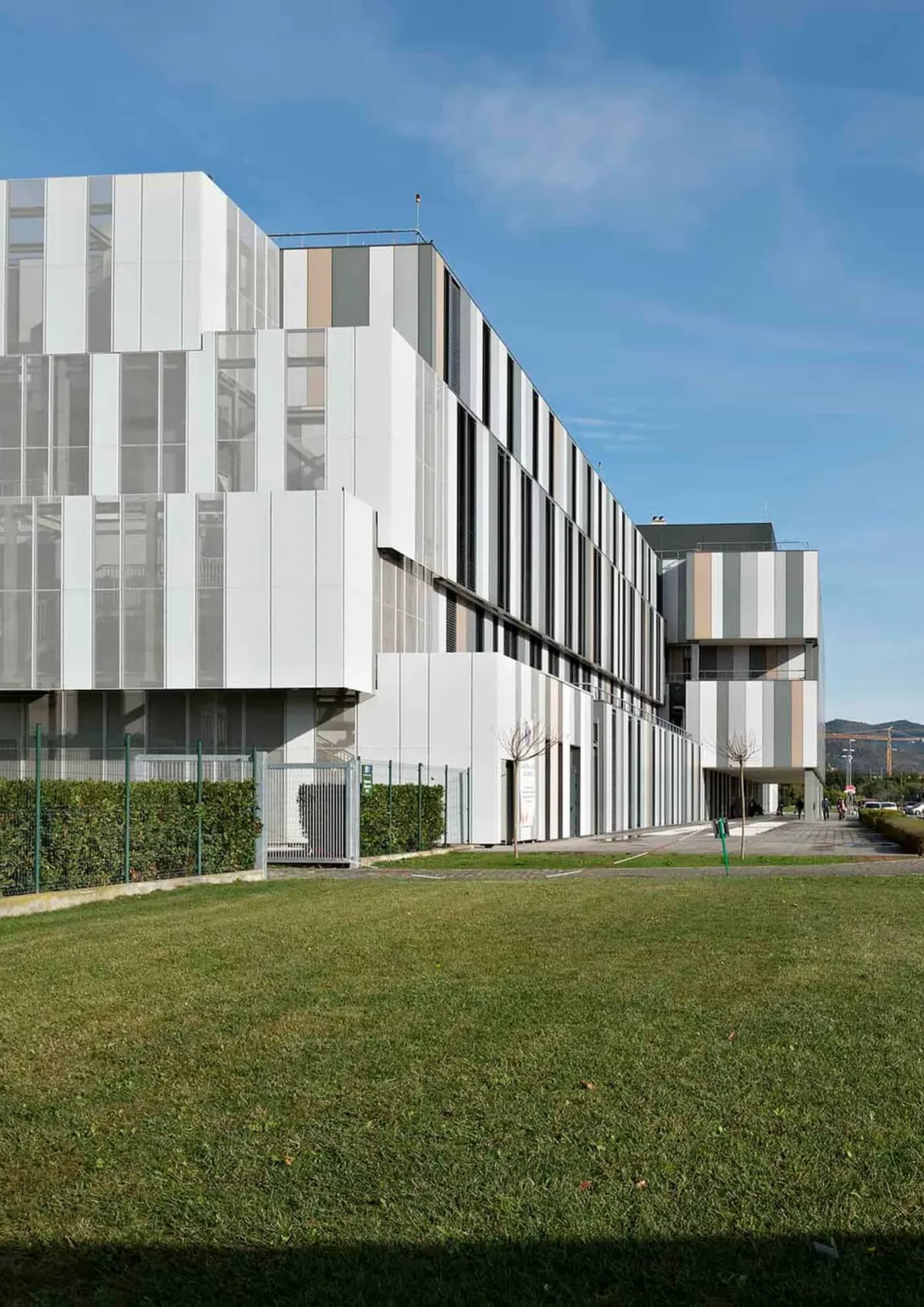
The new Prato hospital is one of four large new hospitals in Tuscany built under project financing. It is part of the Tuscan Hospitals system built by Impresa Pizzarotti, which will also manage it for 25 years. The complex consists of two buildings, the hospital and the service building, for about 60,000 m².
It has 540 beds, 20 short intensive observation units, 40 dialysis stations, 15 operating rooms, 6 labour rooms and 4 delivery rooms. It is a building where systems and maintenance weigh heavily and where every outage affects clinical activity.
For Impresa Pizzarotti, on a project completed in 2022, BIMON delivered the following:
- a BIM model of the hospital and all its MEP systems, including every asset needed for operation, produced from accurate scanning and automated recognition and classification of components;
- data integration from IoT sensors and the BMS, piped into a data platform connected to the hospital's management system;
- analysis of the available data and custom checks on information content, so that information and modelling nonconformities can be monitored over time;
- artificial intelligence algorithms that analyse the collected data and enable predictive maintenance and energy savings;
- simple, accessible dashboards for the people who run the building.
The starting point was the model. The twin works because the model was built for operation, with the assets that maintenance needs, and because the information content is checked over time. It is the sequence described in the roadmap: an as-built for operation, a link to existing systems, then analytics.
For a concession holder with 25 years of operation the return is direct: every failure avoided and every kWh saved stays in the operator's budget. It is the kind of client for whom a digital twin makes the most sense.
| Item | Value |
|---|---|
| Client | Impresa Pizzarotti S.p.A. |
| Year | 2022 |
| Floor area | 60,000 m² |
| Beds | 540 |
| Operating rooms | 15 |
| Dialysis stations | 40 |
| Management period | 25 years |
| Technologies | BIM, Scan to BIM, IoT, BMS, AI |
Chapter 07
When it pays off and the mistakes to avoid
Not every building needs a Digital Twin. Sometimes the right investment is a good as-built model, to which a twin can be added later.
BIM is enough when:
- you need to design or refurbish an asset and coordinate several disciplines;
- the contract is public and above the threshold of article 43 of Italian Legislative Decree 36/2023, or the client asks for it;
- you want to check quantities, costs and schedule before construction;
- you need to hand over a reliable as-built at the end of works.
You need a Digital Twin when:
- you run the asset for many years, as owner, concession holder or operator;
- energy or maintenance costs are high enough to justify data analysis;
- data sources such as BMS, meters and maintenance software already exist, but nobody combines them today;
- there is a recurring decision that current data cannot support.
If none of the conditions in the second list is true, stop at a well-made as-built designed for operation.
The mistakes we see most often:
- Dashboards without a decision loop. A dashboard nobody uses to decide is a cost. Every view must match a decision and a person who takes it.
- Misaligned identifiers. Different codes in the model, the BMS and the CMMS break the link at the first replacement.
- Unverified as-built. The last design revision updated by hand does not match what was built, and the twin inherits the same errors.
- Sensors before questions. Installing sensors without knowing which decision they serve produces data nobody looks at.
- Modelling everything. A model with the same detail everywhere costs a lot and ages quickly. Better to model well what operation needs.
- No data owner. Without rules on who updates the model after interventions, the twin loses value within months.
Chapter 08
Checklist to get started
Use this list before asking for a quote or starting a pilot. If you cannot tick the first four items, the first step is an analysis of your existing data, not a platform.
- I have chosen the first decision the twin must answer
- I know who will take that decision and how often
- I have a list of data sources: BMS, CMMS, meters, drawings, models
- I know which codes each system uses for assets and rooms
- I have a common coding rule across model, BMS and CMMS
- I have a verified as-built model, or I know which areas to survey with Scan to BIM
- The model holds operational attributes, starting from asset codes
- I have collected energy and maintenance costs for recent years
- I have estimated the return with the three buckets: direct savings, avoided costs, reduced risk
- I will add IoT sensors only where a decision requires them
- It is clear who updates the model after each intervention
- For new assets, the exchange information requirements ask for structured operational data
Chapter 09
How BIMON works
We work across the whole chain, from survey to analytical twin. With the Asset Digital Twin solution we build the digital replica of buildings and infrastructure in operation, connected to their real data, for monitoring, predictive maintenance and performance optimisation.
The O&M Digital Twin service covers modelling, data integration and analytics. We start from the digital representation of the building, with a Scan to BIM survey when no model exists, link the model to IoT, BMS and maintenance data, and analyse them with AI algorithms for energy and maintenance.
In design and construction we provide BIM management and coordination, so the handover model is born with the attributes that operation will need.
If you have an asset and a question your current data cannot answer, that is the right place to start. Write to us with the floor area, the building type and the systems you use today: we will start from there.
About BIMON
BIMON is an Italian BIM and Digital Twin company based in Rome and founded in June 2015. We help owners, contractors, architects and engineers design, build and operate buildings and infrastructure with fewer errors, shorter schedules and lower costs.
We work across the whole asset life cycle: BIM management and coordination, MEP design, Scan to BIM, model validation and Digital Twins for operations. We have delivered more than 250 projects worldwide.
Contacts
- info@bimon.it
- Phone
- +39 06 85383064
- Office
- Via Velletri 35, 00199 Rome, Italy
- Web
- bimon.it
This document is for information only and does not constitute legal advice. © BIMON S.r.l. · VAT IT13444611001